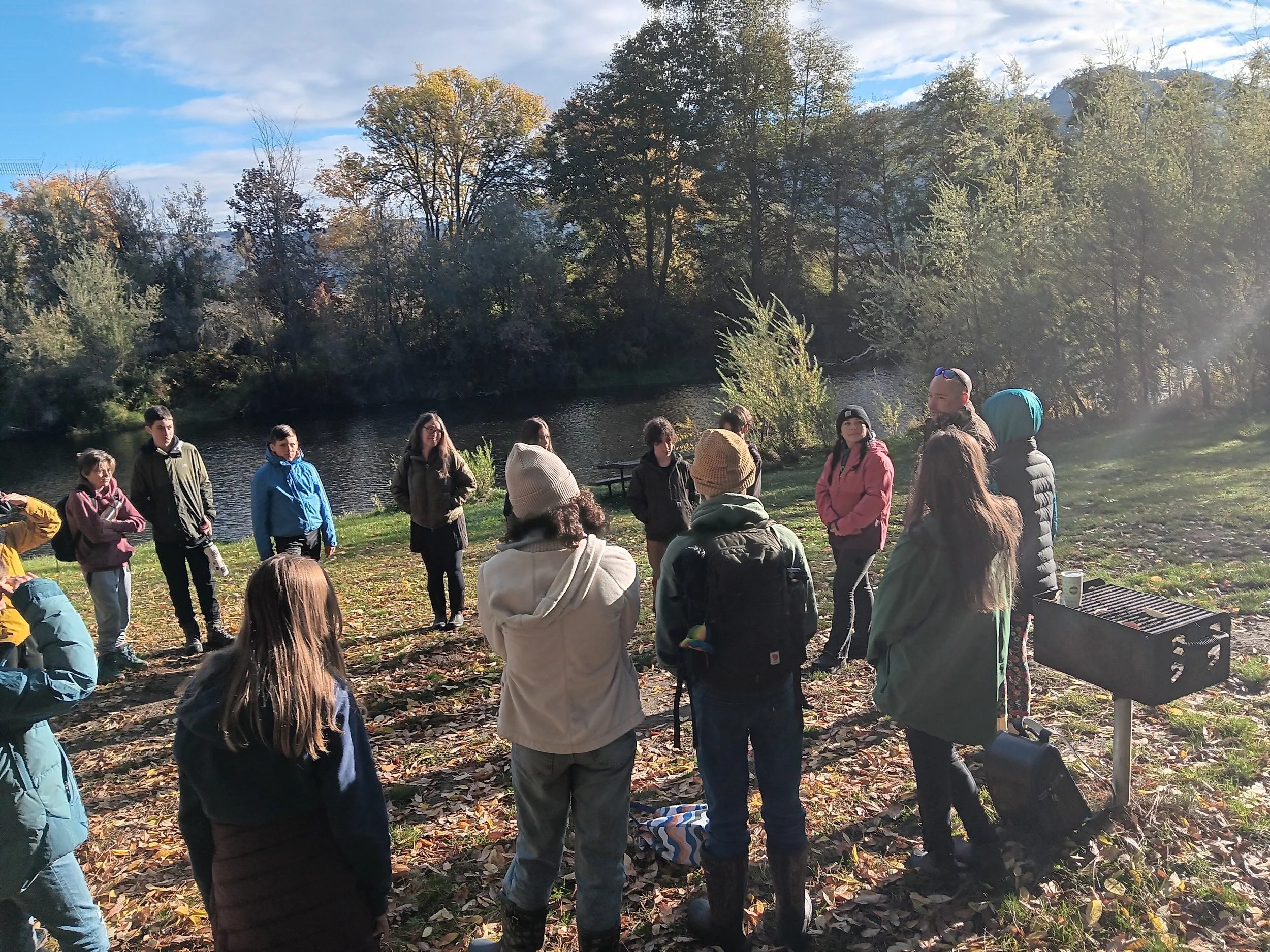
Envision Pathfinders at Pacifica in Williams
Ages 13+
Meets Tues-Thursday, Sept-June
The Pacifica Teens Program is designed for independent learners ages 13 and up who are ready to engage with ideas at a genuine level of depth — and who are ready to learn from a place as much as from a teacher.
Every block is anchored in a core academic subject — Science, Language Arts, Mathematics, or History — but no block stays within disciplinary boundaries. Students conduct original field research, produce real published work, build functional structures, analyze actual finances, and engage with the living community of the Williams Valley and Rogue watershed. The twelve blocks below are organized into three trimesters across the school year, each building on the last.
Subject Rotation for 2026-27
Fall:
Ferment, Grow & Feed: The Science of Food Systems
Chemistry & Biochemistry · Biology · Food Science · Environmental Science · History & Anthropology · Mathematics (Data & Ratios) · Scientific Writing
Students study what food is at the molecular level — macronutrient chemistry, fermentation microbiology, enzyme function, the Maillard reaction, soil nutrition and its relationship to plant biology — and connect that molecular understanding to the living systems operating around them every day.. This is not a cooking class. It is a science class that happens to use one of the most immediate and accessible laboratories available: the food that comes out of this land and into this kitchen.
Students track crops from soil biology through germination through harvest through preservation and fermentation, studying the chemistry occurring at each transition. History and anthropology provide essential context — the agricultural revolution, the development of fermentation traditions across cultures, the industrialization of food production and its consequences, and the politics of food sovereignty. Mathematics enters through composting ratios, yield calculations, nutrient analysis, and the quantitative reasoning behind farm management decisions. The project asks students to design and conduct a multi-week experiment — testing fermentation variables, comparing preservation methods, or analyzing the nutritional chemistry of Pacifica's soil across different growing areas — and present findings as both a formal research report and a piece of science writing aimed at a general audience.
Roots & Remedies: Ethnoscience on Living Land
Ethnobotany · Ethnopharmacology · Ethnoecology · Chemistry · History & Anthropology · Ethics & Law · Botanical Illustration
Before laboratories, before peer review, before scientific journals — there was observation. Thousands of years of it, conducted by people who depended for their survival on understanding exactly how the living world around them worked. This block explores the intersection of indigenous knowledge systems and Western science through four interconnected fields — ethnobotany, ethnobiology, ethnopharmacology, and ethnoecology — using Pacifica's living landscape as the primary field site. Students study the specific plants growing on the land, their medicinal and cultural history, and the indigenous knowledge systems of the Siskiyou region that developed over thousands of years of careful attention to this specific place.
The chemistry is genuine and rigorous: students study the molecular basis of traditional plant medicines, how specific compounds interact with human physiology, and how traditional preparation methods like fermentation and combination often enhanced bioavailability in ways modern research is now validating. The block engages honestly with its most important ethical question: who owns knowledge? When a pharmaceutical company patents a compound derived from a plant an Amazonian community has used for five hundred years, what does justice look like? Students develop their own reasoned positions and produce a final research project tracing one plant found on Pacifica's land from its cultural and ecological origins through its chemistry, its scientific status, and the ethical questions surrounding it.
The Living Map: Place, Power & the Art of Seeing
Descriptive Writing · Geography · Analytical Thinking · Cartography · Mathematics (Scale & Measurement) · Ecology · Place-Based Research
A map is never just a drawing of a place — it is an argument about what matters, who belongs, and what gets left out. This block develops descriptive and analytical writing skills through the art and science of mapmaking, using Pacifica's 400 acres as the primary subject. Students hike the land with notebooks and measuring tools, mapping watershed boundaries, ecological zones, trail systems, historical land use, and the human stories embedded in the landscape. They study how maps have been used as tools of power and exploration across history — how colonial maps erased indigenous place names, how modern data visualizations frame political narratives — and learn to read a map the way a careful reader reads a text: critically, asking who made it, for whom, and what it leaves out.
The interdisciplinary reach is wide. Geography and history provide the context for understanding why maps look the way they do. Mathematics enters through scale, coordinate systems, and the geometry of representing three-dimensional terrain on a flat page. Science grounds the work in real ecological and geological observation. The project asks each student to produce a fully annotated map of a specific part of Pacifica's land — combining original fieldwork, historical research, ecological observation, and written analysis — and present it alongside an essay arguing for what their map reveals that standard representations miss.
Living Differently: Alternative Systems on the Land
Political Science & Economics · Environmental Science & Ecology · Ethics & Philosophy · Systems Thinking · Technology & Society · Community Studies
Pacifica itself is an alternative system — a plant nursery, a community land trust, and a living experiment in what it looks like to organize human life around the health of the land rather than the extraction of it. This block uses Pacifica as the primary case study for a rigorous academic exploration of alternative human systems: intentional communities and ecovillages, gift economies and barter, traditional medicine and food sovereignty, decentralized energy, and the emerging question of how to integrate technology — including AI — in ways that expand rather than diminish human potential and ecological health.
Students don't just read about these ideas. They investigate the systems operating around them every day at Pacifica — how decisions get made, how resources flow, how the place sustains itself financially and ecologically — and compare those systems to both conventional models and other documented alternatives around the world. Political science and economics provide the analytical frameworks: gift economies, mutual aid, commons-based resource management, and the political philosophy behind decentralization and self-governance.
Environmental science grounds the course in living models. The block is not utopian. It asks students to evaluate what actually works, what doesn't, and why — developing the analytical and ethical frameworks to think seriously about how the world could be organized differently. The project asks students to design a functioning alternative system for a specific human need at the community scale and defend it as a real proposal.
Winter:
How Shall We Live Here: Philosophy, Ethics & Land
History of Philosophy · Ethics · Ecology · Political Science & Law · Language Arts & Rhetoric · Place-Based Inquiry
What does living well on this land require of us? This block studies philosophy and ethics through the lens of place — using Pacifica's landscape as both classroom and text. Students read across philosophical traditions — Stoicism, indigenous cosmology, deep ecology, Buddhist ethics, existentialism — always asking the same question: what do these frameworks say about the proper relationship between human beings and the living world? The examined life, here, is not an abstract exercise. It is conducted on a specific piece of land, in a specific bioregion, with specific responsibilities.
The history of Western philosophy's understanding of nature provides essential context — from Aristotle and Descartes through Romanticism and American Transcendentalism to the contemporary rights-of-nature movement. Ecology grounds the course in science: students connect philosophical frameworks to their real-world ecological consequences, asking what happens to land managed under extractive vs. relational philosophies. Political science and law bring the course into the present: the emerging legal concept of rights of nature, environmental protection as a philosophical battleground, and what indigenous sovereignty means for how we understand land ownership and stewardship. Part of the project asks students to write and present a personal philosophy of land — a rigorous, well-argued document that articulates their own position on what humans owe the earth and what it owes them.
The Writer's Field: Nature, Place & Long-Form Writing
Literary Arts · Field Observation · Ecology & Natural Science · History & Philosophy · Psychology of Attention · Revision & Craft
Writing about a place you actually inhabit is a fundamentally different act than writing about somewhere you visited. This course takes that difference seriously. Students develop long-form writing skills rooted in direct, sustained experience of Pacifica's specific landscape — its riparian corridors, forest edges, meadows, gardens, and working farm — over the full five weeks of the block. The approach is not recreational. It is disciplined, rigorous, and grounded in the understanding that good nature writing requires genuine knowledge of what you're looking at: the name of the plant, the behavior of the animal, the history of the land, the chemistry of the soil. Students develop their scientific eye and their literary voice simultaneously, because at their best these are not separate faculties.
The course draws on the tradition of place-based writing — Wendell Berry farming and writing on the same land for fifty years, Gary Snyder walking and working the foothills of the Sierra Nevada, Robin Wall Kimmerer bringing a botanist's precision and an indigenous woman's love to the same patch of ground — writers for whom the local was never small but always the opening into everything that matters. Students spend significant time in the field with notebooks, returning to the same spots across the block to track change, deepen observation, and resist the human tendency to stop seeing what we see every day. The music studio offers a creative extension for students drawn to sound and song as forms of place-based expression. The project asks each student to produce a single substantial piece of long-form writing — deeply revised, rooted in direct experience of this land — submitted to a real publication or competition before the block ends.
Water, Power & the West: Hydrology, History & Politics
Earth Science & Hydrology · Water Chemistry · Mathematics (Measurement & Data) · Political Science & History · Indigenous Water Rights · Environmental Ethics
Water is the defining resource of the American West — and the Klamath watershed, which includes Pacifica's land, is one of the most contested and ecologically significant water systems in the country. This block combines rigorous hydrology and water science with the political, historical, and ethical dimensions of water as a finite and deeply contested resource. Students conduct real water monitoring on Pacifica's land: testing water quality, measuring flow rates, mapping drainage patterns, and tracking seasonal change over time. The science is genuine and the data is real — students are contributing to an actual record of this watershed's health.
History and political science provide the essential context. Students study the history of water rights in the American West, the construction and removal of dams on the Klamath, indigenous water sovereignty and the legal battles that continue today, and the contemporary political economy of water as climate change reshapes availability across the region. Mathematics enters through the quantitative analysis of water data: flow rate calculations, statistical analysis of quality measurements, modeling of seasonal variation, and the mathematics of water rights allocation. The project asks students to produce a comprehensive water report on a specific section of Pacifica's watershed — combining field data, historical research, and a policy recommendation section addressed to a real decision-maker.
The Long View: Deep History of a Living Landscape
Geology & Earth History · Indigenous History & Culture · Archaeology · Oral History · Environmental History · Research Methods · Place-Based Writing
Every acre of Pacifica's land has been shaped by forces operating across millions of years — tectonic shifts, glaciation, volcanic activity, the slow work of water on stone — and inhabited by human beings for at least ten thousand of them. This block studies history at the deepest possible scale, using Pacifica's specific landscape as the primary text. Students work like historians and archaeologists, reading the land itself as a primary source: rock formations that record geological events, soil profiles that reveal centuries of ecological change, trail patterns that follow routes established long before any European arrived, plant communities shaped by thousands of years of indigenous land management.
The block moves through deep time in layers. Geology and earth science establish the physical foundation: how the Siskiyou Mountains formed, what the rock faces at Pacifica reveal about deep earth history, how the watershed developed.
Spring:
Community, Leadership & the Land
History & Political Science · Psychology · Civics & Community Organizing · Ethics · Place-Based Leadership · Communication & Advocacy
Leadership is not a personality trait. It is a practice — a set of learnable skills that history's most consequential people developed through study, failure, and sustained commitment to something larger than themselves. This block examines the history and practice of leadership through the specific lens of land stewardship and community organizing in the Siskiyou region — studying people who changed things without institutional power and asking what made them worth following. Students read primary texts alongside the living examples around them: the farmers, activists, tribal members, conservationists, and community builders who are doing real work in the Williams Valley and the broader Rogue watershed right now.
Psychology brings the science: group dynamics, social influence, motivation theory, and the research on what makes someone genuinely trustworthy rather than merely persuasive. Political science and civics ground the course in the present: how institutions are built and changed, how community organizing actually works, and what the relationship between individual agency and systemic power looks like when the system in question is a watershed, a farm, or a rural community trying to survive economic pressure. The course project is place-specific and real: students identify a genuine gap or need in the Pacifica community or the wider Williams Valley, design an initiative to address it, reach out to real community members and organizations, and take the first concrete steps toward making it happen.
Earth & Hand: Natural Building, Design & Material Science
Environmental Science · Material Science · Structural Engineering · Mathematics (Load & Geometry) · Woodworking · History of Architecture · Technical Writing
This block sits at the intersection of science, mathematics, history, and craft — and Pacifica's woodworking studio and surrounding land make it possible in a way that no conventional classroom could. Students study how natural building materials are formed, sourced, and processed by the earth itself — the chemistry of clay, the structural physics of timber, the thermal properties of straw and stone — and connect that scientific understanding to the long human tradition of building with what the land provides. The environmental stakes are real and engaged with seriously: conventional construction is one of the most ecologically damaging industries on the planet, and natural building offers a fundamentally different relationship between human shelter and the living world.
History runs throughout — from ancient Mesopotamian mud brick to Pueblo adobe to West African earthen architecture to the vernacular building traditions of the Pacific Northwest — revealing that some of the most sophisticated structural knowledge humans ever developed is encoded in traditions that modernity has largely discarded. Mathematics enters through load distribution, material ratios, thermal mass calculations, and the structural geometry students use to design things that actually stand. The woodworking studio is central to the hands-on dimension of the block: students work with real tools, real materials, and the real consequences of imprecise measurement. The project asks students to design and build a functional structure on Pacifica's land — moving through the complete arc from site assessment through material sourcing, blueprinting, construction, and a written portfolio documenting every stage of the process.
The Economics of Land: Farm Finance, Resource Management & Sustainable Agriculture
Mathematics · Economics & Finance · Environmental Science · History of Agriculture · Political Science · Data Analysis · Technical Writing
What does it actually cost to farm land — and what does it give back? This block takes the mathematics and mechanics of personal and institutional economics and grounds them entirely in the reality of a farm operation. Students learn budgeting, yield calculation, pricing, cash flow modeling, and basic bookkeeping not as abstract financial exercises but as the actual tools required to keep a small sustainable farm viable. Every number has a real-world source: crop yields, input costs, market prices, labor hours, water usage, soil amendment expenses, and the complex financial relationship between a farm that prioritizes ecological health and a market economy that doesn't always reward it.
The block zooms out to the broader political economy of agriculture in America — how industrial farming is subsidized while small sustainable operations are not, how land value and ownership patterns have shifted over generations, and what the economics of regenerative agriculture actually look like at scale. History traces the arc from subsistence farming through the Green Revolution to contemporary food systems, connecting today's farm economics to the decisions made by governments, corporations, and communities over the past century.
The Field Naturalist: Ecology, Observation & Scientific Writing
Ecology & Biology · Field Science · Scientific Writing · Data Collection & Analysis · Fishing · Watershed Studies · Mycology · Scientific Illustration
This block trains students in the discipline of the working naturalist — the ability to go outside, pay close attention, and record what is actually there with scientific accuracy and literary precision. Pacifica's land is the laboratory: its soil communities, mycorrhizal networks, watershed ecology, plant-animal relationships, and seasonal cycles provide an endlessly complex system for students to investigate over five weeks of sustained fieldwork. Hiking and fishing are primary research methods — students learn to read a riverbank the way a biologist reads data, understanding what the presence or absence of particular species tells them about water quality, habitat health, and ecological balance.
Students keep rigorous field journals throughout the block, developing scientific observation skills alongside the writing craft required to communicate findings clearly and compellingly. Data collection, species identification, food web mapping, and the design of original field studies are all central to the work. The block connects to the history of naturalism — from the tradition of Muir and Leopold to contemporary conservation biology — and engages honestly with the ethics of human presence in wild systems. Spring is the ideal season for this block: the land is at its most active, migration patterns are visible, plant emergence is trackable week by week, and the watershed is running with snowmelt. The project asks students to design and conduct an original multi-week field study on Pacifica's land, publishing findings as a formal scientific report complete with original illustrations, data analysis, and a discussion of what their findings mean for the stewardship of this specific place.